First Impressions of Working at Lapland University of Applied Sciences

20250107_1219105867966273984800587

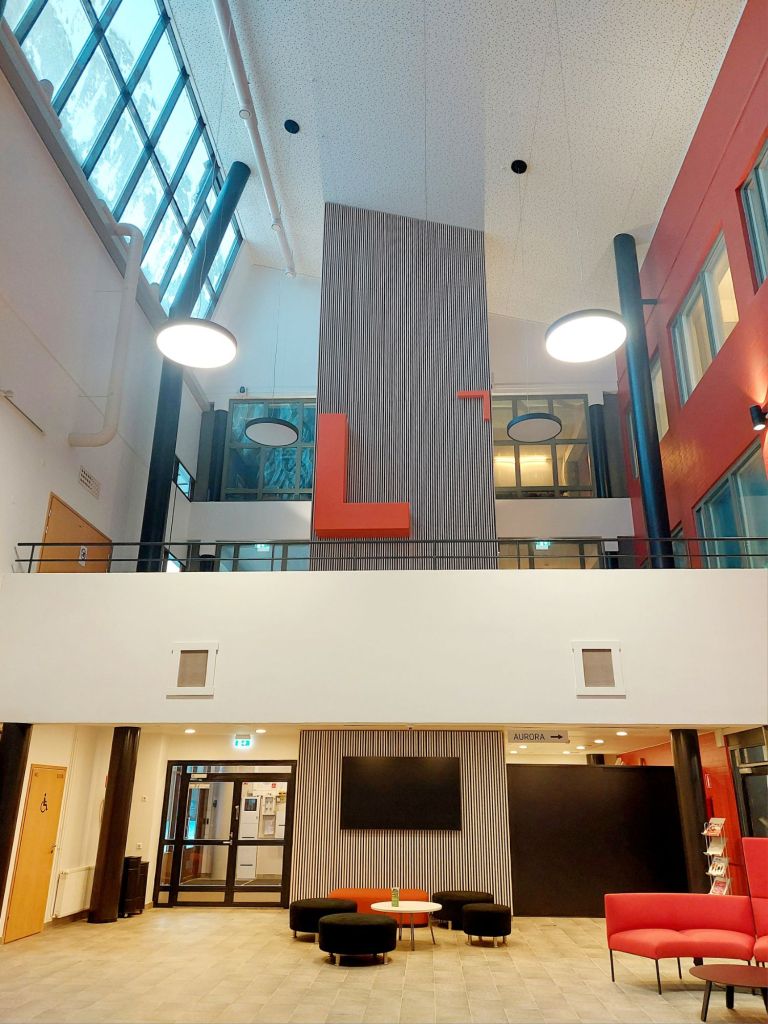
I started working as a teacher of communication, academic writing, and sports psychology at Lapland University of Applied Sciences in Rovaniemi at the beginning of January. The work has started well. After initially getting to grips with the tools and working methods, I feel I have adapted excellently to the daily life of the institution. The work community seems very enthusiastic and productive, and integrating into such an environment has been easy for me. My broad expertise – with various tasks and a long academic history – supports my success in this job.

In many situations, as I familiarize myself with the level of education and the institution’s operational culture, I have found myself already immersed in the work. The terminology related to employment at the university of applied sciences is quite similar to what I was used to in vocational education. Lapland as an environment is different compared to, for example, Helsinki or Southern Ostrobothnia, but we are all working towards future dreams. In other words, I get to help students on their path to becoming professionals in their future fields.

Over the past week, alongside my other work, I have taken on tasks related to the publication process at Lapland University of Applied Sciences. This means I participate as a commentator on blog posts published in the Pohjoisen tekijät (“The Northern Factors”) blog. I also participate in students’ thesis processes, particularly as an expert in academic text conventions. I also contribute to publishing within my own expertise. I am already familiar with publishing, having written my own blog for years and published various print and other materials. My goal in the near future is to master podcast publishing, for which we have excellent facilities – and a lot to learn.

I believe that universities of applied sciences are entirely equal to traditional science universities. I have encountered a similar situation regarding the status of educational institutions while working in vocational education. Vocational education can be fully competitive with high school education. Both provide the readiness to study and later work at a higher education level. The operational culture of the institution must be such that all parties understand the future directions in which the education level operates. Similarly, the university of applied sciences level is fully competitive with traditional universities – each has its own focus. On the university of applied sciences side, I emphasize to students the importance of writing according to academic conventions, where they simultaneously process new information in their assignments and demonstrate to the evaluating teacher their ability to produce academically valid text. This is where my field, academic writing, comes into play. Equally important in learning processes is adhering to schedules.

My success in this job is truly the result of long-term study and, above all, working in vocational education. Research writing is a crucial part of higher education studies. I have a lot to contribute in this area in the future. This applies to both the institutional level and the students’ work. With enthusiasm and interest, I continue to explore the world of higher education.

Ensivaikutelmia työskentelystä Lapin ammattikorkeakoulussa

Aloitin tammikuun alussa työskentelyn viestinnän, akateemisen kirjoittamisen ja liikunta- ja urheilupsykologian opettajana Lapin ammattikorkeakoulussa Rovaniemellä. Työt ovat alkaneet hyvin, ja alun työvälineiden ja työskentelytapojen haltuunoton jälkeen koen sopeutuneeni erinomaisesti oppilaitoksen arkeen. Työyhteisö vaikuttaa erittäin innostuneelta ja aikaansaavalta, ja sellaiseen mukaan pääseminen on käynyt minulta helposti. Myös laaja-alainen osaamiseni – lukuisat erilaiset työtehtävät ja pitkä opintohistoriani – tukee erinomaisesti työssä onnistumista.

Oikeastaan voidaan sanoa, että monessa tilanteessa perehtyessäni koulutusasteeseen ja oppilaitoksen toimintakulttuuriin, olen todennut olevani jo sisällä tekemisessä. Ammattikorkeakoulumaailma toimii melko pitkälle samalla työsuhteeseen liittyvällä terminologialla, johon olen tottunut ammatillisella perusasteella toimiessani. Lappi toimintaympäristönä on erilainen vaikkapa verrattuna Helsinkiin tai Etelä-Pohjanmaahan, mutta työskentelemme yhtä kaikki tulevaisuuden unelmien parissa. Toisin sanoen saan auttaa opiskelijoita heidän omalla polullaan kohti oman tulevan alansa ammattilaisuutta.

Olen viimeisen reilun viikon aikana ottanut haltuun muun työni ohella Lapin ammattikorkeakoulun julkaisuprosessiin liittyviä työtehtäviä. Toisin sanoen osallistun kommentoijana julkaistuihin Pohjoisen tekijät -blogin blogiteksteihin. Yhtä lailla osallistun opiskelijoiden opinnäytetyöprosesseihin erityisesti akateemisiin tekstikonventioihin liittyvänä asiantuntijana. Mahdollisesti itsekin tulen osallistumaan julkaisemiseen oman asiantuntijuuteni puitteissa. Itse julkaisutoiminta on minulle tuttua jo pitkältä ajalta kirjoitettuani jo vuosia omaa blogiani sekä julkaistuani erilaisia printti- ja muita materiaaleja. Samalla lähiaikojen tavoitteenani on ottaa haltuun podcast-julkaisemista, johon ainakin välineiden osalta on erinomaiset puitteet – ja samalla paljon opittavaa.

Mielestäni ammattikorkeakoulu on täysin tasa-arvoinen oppilaitostaso tiedeyliopistoiden kanssa. Samanlaiseen asetelmaan oppilaitosten statuksen osalta olen törmännyt menneinä vuosina työskennellessäni toisella asteella ammatillisten perustutkintojen parissa. Amis on parhaimmillaan täysin kilpailukykyinen koulutustaso lukion kanssa. Kumpikin luo nykypäivänä valmiuksia opiskella ja myöhemmin vaikkapa työskennellä korkea-asteella. Oppilaitoksen toimintakulttuuri vain täytyy tehdä sellaiseksi, että kaikki tahot ymmärtävät, millaisten tulevaisuuden suuntien kanssa koulutusasteella toimitaan. Vastaavalla tavalla ammattikorkeakoulutaso on täysin kilpailukykyinen koulutustaso tiedeyliopiston rinnalla – kummallakin on omanlaisensa fokus. Ammattikorkeakoulun puolella painotan opiskelijoille akateemisten konventioiden mukaista tapaa kirjoittaa, jolloin samanaikaisesti opiskelijat oppimistehtävissään prosessoivat itselleen uutta tietoa sekä osoittavat arvioivalle opettajalle kykenevänsä tuottamaan akateemisesti pätevää tekstiä. Tässä oma alani, akateeminen kirjoittaminen, astuu mukaan kuvaan. Yhtä lailla pidän erittäin tärkeänä oppimisprosesseissa, että aikataulutuksesta pidetään kiinni.

Omalla kohdallani onnistuminen työssä on todella pitkäaikaisen opiskelun ja ennen kaikkea ammatillisella perusasteella työskentelemisen tuotetta. Tutkimuskirjoittaminen on hyvin tärkeä osa korkea-asteen opintoja, ja tämän oivalluttamisessa minulla on tulevaisuudessa paljonkin tehtävää. Tämä koskee niin oppilaitostasoa kuin opiskelijoidenkin työskentelyä. Innostuksella ja kiinnostuksella jatkan tutustumista korkeakoulutuksen maailmaan.
Attending the ABC Summer School

abc logo

As I told earlier, I spent two weeks in Amsterdam in June studying, cycling and seeing the city. Now the summer school is over and it’s time to make a short summary about things I learned and experienced. To be honest, I wanted to write a travelogue to my blog, but sorry to say I was far too busy and exhausted to do that during my trip. The course itself was very challenging for a part-time student like me, but after two weeks of school work I completed the course along with my young student colleagues.

Students from the Netherlands, Germany, Poland, Romania… and Finland

ABC Summer School 2018 brought together students from different universities all over Europe. There were students at least from the Netherlands, Poland, Germany, Romania, Canada… and me from Finland. The major part of the students were studying in the research master program in the University of Amsterdam, but many of them were also studying different master’s degrees in the University of Leiden, Utrecht University, the Hague Universitythe Radboud University in Nijmegen and many others.

I don’t study in a master’s program, so it was a bit tough to adapt to studying in English in such a short time we had in Amsterdam – especially when the terminology of neuroscience was quite unfamiliar to me. However, in my opinion, I succeeded quite well despite some difficulties I had with the topic.

Excellent lessons

The course itself consisted of two parts: 1) lessons and 2) workshops. Or actually there was also the third and the most important part, which is my own learning and time used to it. But that is quite an obvious part of studying, so I concentrate on the first two parts. Of course I could have used more time for my own reading, but there was also much to see in Amsterdam, and I had decided to take it a bit easier with the course. In the workshops we were instructed by tutors, and our goal was to create three things for our research plan: 1) a study proposal, 2) an A0-sized poster and 3) a pecha kucha presentation. For these things we had two weeks of time, so we couldn’t really waste time during the course.

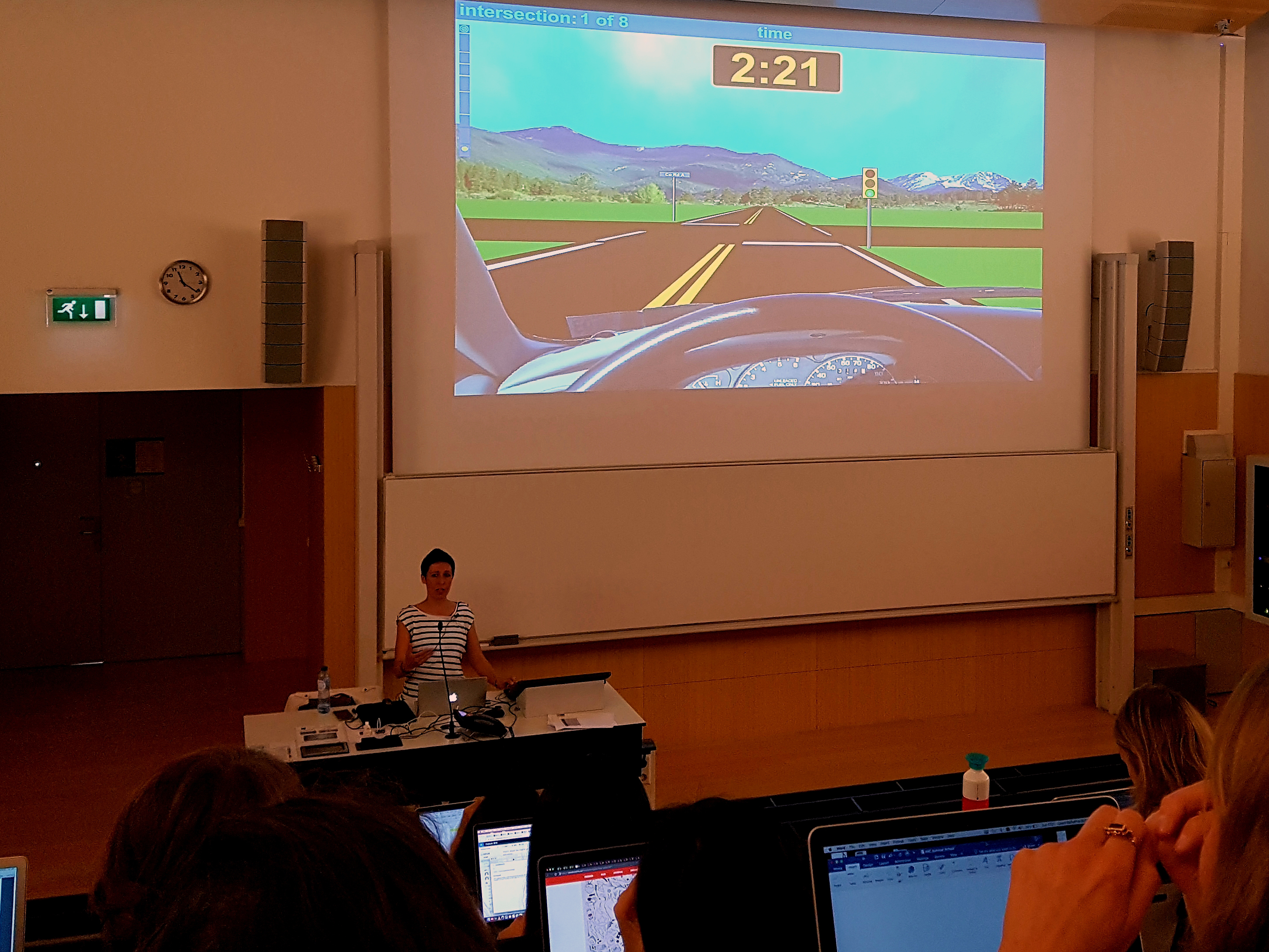
Every morning from Monday to Friday days started with morning lessons given by professors from different universities. They all spoke of different fields of neuroscience. Topics were from their own interests and study projects. All these phenomena were researched by the methods of neuroscience. For example my own interest is understanding decision-making, that was introduced by for example prof. dr. Berna Güroglu, whose traffic example was pretty much like my own plan in my previous post. Traffic is an interesting subject, because it includes so many common rules and ways of acting. Traffic is also a social environment, where we have to take other people into account. Our own research plan was to try to model these social environmental stimuli on norm compliance, which made traffic example very interesting, too.

Decision making - neuropsychology.jpg
Prof. dr. Berna Güroglu talked for example about decision-making in traffic.

Study proposal, poste and Pecha Kucha presentation

For me it was completely a new thing to do a study proposal, poster and pecha kucha presentation of our research plan, so already seeing the form of them was new for me. But I got really good advices from my student colleagues and tutor for doing them. For them all these things seemed to be a business as usual type of thing in their studies, so I had excellent exercise when participating our team work and seeing my student colleagues working.

Study proposal, as I understood it right, is the document, that is done at first when planning a research. It’s like a supporting framework for all the other things, and with your proposal you sell your idea to for example university and to potential financiers. But when I wrote my own master’s thesis in 2012–13, I didn’t write any kind of proposal, although I should have written if I consider it now. Anyway. I wrote my thesis without any proposal and that’s it. But if you want to do a real research, that you want to sell to someone, a study proposal and a poster are probably something you should do.

So, we did our proposal and poster plus prepared our pecha kucha presentation, that we gave to the other students and tutors. And here’s our poster, where we could have used a bit more pictures. But anyway, in my opinion that was the best research poster I have ever done. Let’s forget the fact, that it’s also the only one I’ve ever done. Anyway, it was also interesting to see and hear the other students’ research plans and how they had planned to research the phenomena they were interested in. Some of the students told, that they are really going to put their plans into practice in the future. That sounds great, when these students were able to use this course as a stepping stone towards their own research.

Summer school.jpg
Presenting the posters of the research plans.

Final thoughts of the course

The course was very interesting, and it gave me a lot to think about – which obviously was the main point when attending the course. First of all it was really nice to be able to participate the ABC Summer School 2018. All the people were very supportive and nice, and the course itself was well organized. I want to thank the staff of Amsterdam Brain and Cognition unit for these excellent two weeks. I really keep my thumbs up for you and also all my student colleagues from different universities. Many of them are going to do their master’s thesis in the near future, and they’ll need a lot of positive energy to their work.

My time in Amsterdam was really intensive, but also very nice and rewarding. I also learned a lot, and was able to use my English in practice, which was one of the main points when decided to study abroad. I really recommend this kind of combination for anyone interested in both traveling and learning.

A Bit Different Summer Holiday

Today I’m starting my summer holiday, that is going to be a bit different from the ones before. This summer I am mixing my interests – traveling and studying – attending The 2018 Amsterdam Brain and Cognition (ABC) summer school of the Universiteit van Amsterdam.

I am going to write my travelogue on my blog and warmly welcome you to join my journey.

Amsterdam.jpg

Lifelong Learning as a Beneficial Hobby

I love studying and world of learning. To be honest, learning new things plays an important role in my life as an essential lifestyle. My dear friend Johanna describes the same thing as follows: “My hobby is overeducating myself.” And that’s exactly what I’m trying to do, too! Learning is simply so much fun and it benefits us all when applying for jobs, for example. Studying creates possibilities in life, and that gives me both safety and freedom. Besides it’s very nice to start understanding new things about world and it’s phenomena.

yliopisto
Main building of my home university, the University of Helsinki.

I started my university studying career already in year 2000, when I made my first university courses and finally basic studies in education theory at the University of Helsinki. Since then I have done my Master of Arts degree in Finnish language and my overall ECTS amount is some 500 with several basic and intermediate studies – like psychology, leadership & management, communication and statistics. I also studied vocational teacher studies at the Haaga-Helia School of Vocational Teacher Education in 2016-17.

Our world is changing fast, and we must be ready to face these large-scale changes and adapt to them. Education is an excellent way to prepare ourselves for changes, widen our worldview and create new possibilities to ourselves. In addition at least in Finland high quality education is within everybody’s reach. However more and more people seem to be unmotivated, because learning means work and takes time. In our fast-paced high-tech world everything should happen in a flash, and this kind of long-term learning process is far too slow for many people. For this kind of learning process we need dreams, patience, discipline, focus and work. Well, these things are definitely my strength.

I won’t give up studying and improving my own professional skills, and at the moment it’s time to do some study planning for the spring period. I hope to see more and more people getting interested in studying and learning for their own future.